When do Babies Start Using Utensils?
“Don’t worry too much – your baby will handle it soon.”
Around 6-8 months some parents take their children to developmental classes mainly aimed at improving motor skills. Their children are taught to use spoons, plates, and other utensils.
For a mother there is nothing more desirable than for her child to become independent as soon as possible.
When do Babies Start Using Utensils
To start using cutlery means to use them for their intended purpose and not for play. Most children who already sit are pulling everything in their hands and mouths. To say that the child knows how to use them from 4 months is impossible.
So when do babies start using utilities? Starting from 6 month old many parents teach their child use to a cup. Statistically kids learn that a little later in their development, but introducing difficulties earlier does speed up the process.
1. Spoon – 12 to 16 months
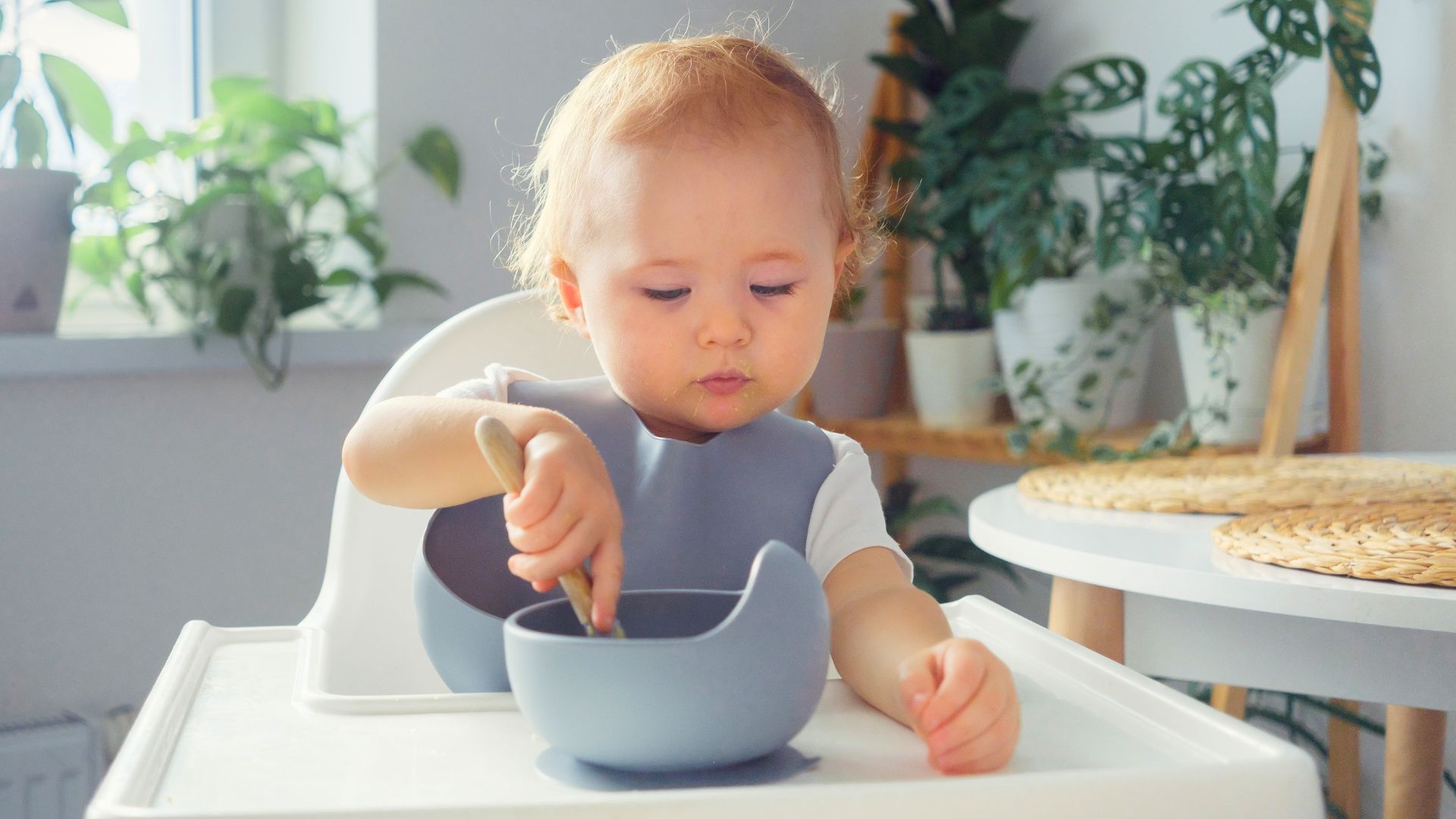
To form behavior babies start mastering the spoon from 5 months. At first, the mother feeds with a spoon and child simply studies and observes the process.
The information is recorded and starting from the age of one. Children pull the spoon out of their mother’s hands and try to eat on their own. This does not happen very neatly and by 14 months babies cope with this task.
All babies develop at their own pace. We can assume that the age of the full use of a spoon as cutlery begins from 1 year.









































Baby’s Safety When Using utensils
Children under the age of 2-3 years are still extremely dangerous for themselves. They still tend to pull everything into their mouths.
Studying new objects and the possibilities of his body, the child can inflict various injuries on himself. Parents need to be strict supervisors to their kids and make sure nothing happens while using utensils.
If you see that your child is completely independent, don’t yet leave him alone with the utilities for a long time. To introduce the development of new cutlery choose a quality manufacturer of these products. The spoon should not be too small so that the child cannot stick it deep into the mouth or nose. Start with to using silicone spoons.
Forks should never be sharp. Buy appliances with rounded edges. Start with plastic and gradually they can be replaced with sharper metal ones.
It is better to choose plates that do not break. Now there are many different options for plastic dishes. If you do not like plastic, choose more expensive manufacturers who have non-breakable dishes. By looks it will not differ from ceramic, but when dropped it will not break into small pieces.
How to deal with a knife?
There are good plastic knives with cutters on a rounded blade. They cut perfectly and are suitable for the first steps in mastering this device. In the future, it is better to purchase a real serving knife additional protection of round edge.
Safety in the development of cutlery lies entirely on the shoulders of the parents. Remember that a child is always at risk if left alone with something new and potentially dangerous.
Learning Utensils at Daycare
Modern standards require children to already have the skills to enter kindergarten. Now the child should be able to dress himself, go to the toilet and eat.
Many mothers in position to send their child to kindergarten way before kids turn 3 years old. In nursery groups children don’t always able to learn skills to serve themselves on their own. Nannies help the kids in adapting to the conditions of the kindergarten.
As a rule, children under 2 years old already have primary skills in working with cutlery except knife. Kindergarten only pushes the child to even greater independence. Babies in the kindergarten have a large number of examples of at least 10 – 15 of the peers. The level of development of all children is different, but they always reach for those around them in development.
Working in a group is much easier than learning a skill on your own. That is why many mothers who send their children to kindergarten are seeing tremendous progress in their development.
Being in society without the support of the mother, the child becomes more independent. Already by the age of 4–5, a mother can hear her child’s stories about how they were taught to eat with a knife and fork in kindergarten.
How to Speed Up Learning Process
Mothers always strive to ensure that their child becomes independent as early as possible. Pediatricians and psychologists insist that everything has its time and there is no need to rush. New skills and abilities are acquired by children based on their life experiences. The sooner you give your child this experience, the faster he will learn new things.
To speed up the process of mastering cutlery by a child give it to them as soon as possible. Let him think, touch, try to touch, and even taste. Do not prevent baby from contacting new and interesting tool.
Through play children learn many new skills and abilities. Therefore, it can be used for the development of cutlery. Through the game child will not be bored at the table. Count together the number of pricked peas on a fork.
A wide variety of children’s dishes allows you to draw the child’s attention to the process of eating. You can buy a plate at the bottom of which cartoon characters appear. A fork or spoon can be bought with a handle in the form of an airplane.
The best way to speed up the process of mastering cutlery is to give your child as much independence as possible. Mothers should not feed children from a spoon until 3 years old.



latest video

news via inbox
Nulla turp dis cursus. Integer liberos euismod pretium faucibua